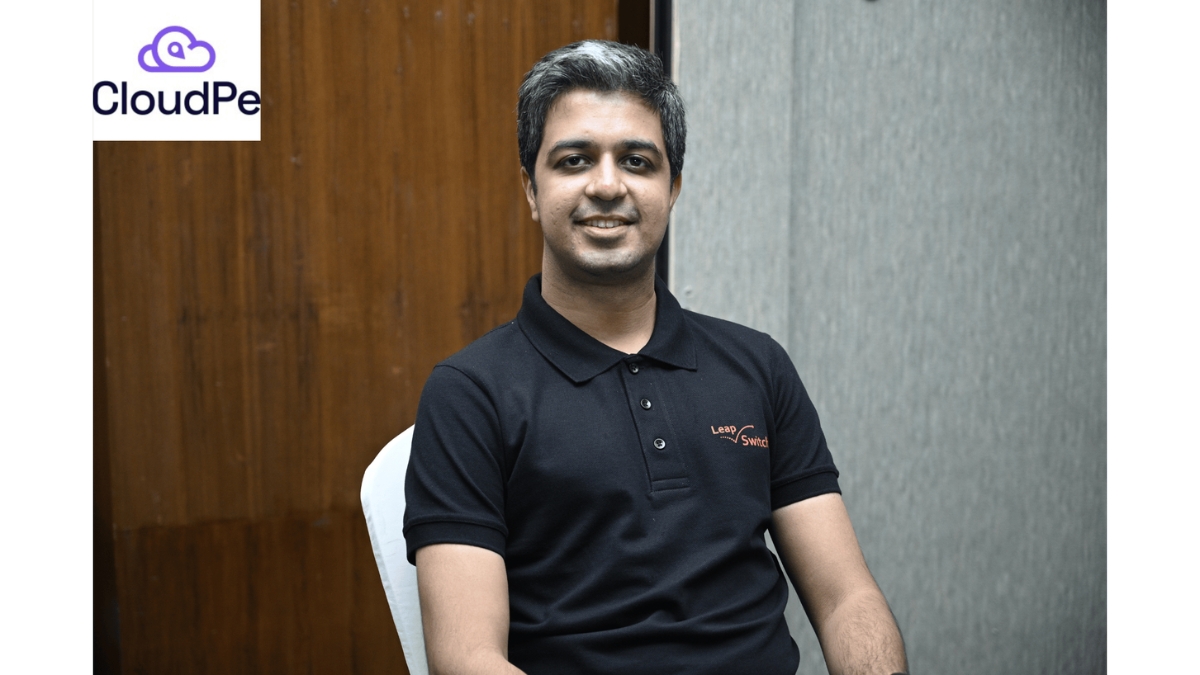
Ishan Talathi – Co-Founder, CloudPe
Mumbai (Maharashtra) [India], June 3: In 2006, a small technology company called LaceHost started operations in Pune with a simple ambition — to make reliable web hosting accessible and affordable for Indian businesses at a time when cloud computing was barely a mainstream concept. Few would have predicted then that this modest beginning would eventually evolve into a direct challenge to Amazon Web Services on Indian soil.
Nearly two decades later, that company — now known as Leapswitch Networks — has launched CloudPe, a full-stack cloud infrastructure platform offering enterprise-grade compute, managed Kubernetes, GPU cloud, and object storage. The ambition is no longer modest. India’s cloud computing market is estimated at — and CloudPe is positioning itself as a serious domestic contender for a meaningful share of that opportunity.
A Foundation Built Over Two Decades
What began as LaceHost in 2006 rebranded itself into Leapswitch Networks in 2009. From the early days of building a reliable hosting service, Leapswitch expanded its footprint beyond India — first setting up data centres in the United States, then moving into Europe, and eventually strengthening its presence in India by opening its first Indian office in Mumbai in 2014.
Today, the company operates from 19 worldwide locations across 10 countries and three continents, serving customers from 110 countries — ranging from startups and developers to small businesses and enterprises transitioning to digital infrastructure. That is not the profile of a scrappy newcomer. It is the track record of an organisation that has spent the better part of two decades learning what enterprise infrastructure reliability actually requires.
Along the way, Leapswitch also grew through strategic acquisitions of XOZZ, WhynotaVPS, and Stromonic, as well as a merger with Strad Solutions — each move designed to expand capabilities, enhance customer experience, and explore new markets. The introduction of CloudPe further expanded the company’s offerings, making advanced Infrastructure-as-a-Service solutions accessible to organisations of every size.
CloudPe is therefore not a pivot — it is a graduation. The infrastructure expertise, the operational discipline, and the customer support culture built over nearly two decades in hosting now underpin a platform that competes directly with global hyperscalers on compute, storage, networking, and GPU cloud.
Why the Market Timing Is Right
The window CloudPe is entering could not be more strategically significant. According to IDC, the Indian public cloud services market was expected to touch $13.5 billion by 2026 from $4.6 billion in 2021, growing at a CAGR of 24% — outpacing the global cloud market in terms of growth rate.
But rapid market growth alone does not explain the opportunity. What makes this moment particularly compelling for a domestic challenger is the convergence of three structural shifts happening simultaneously in Indian enterprise IT.
The first is regulatory. India’s Digital Personal Data Protection Act, 2023, has established a national framework for handling personal data, with April 2026 marking the critical mid-way point of the 18-month transition window leading to full enforcement in May 2027 — a mandatory timeline for enterprises to re-architect systems for compliance by design. For organisations relying on cloud providers governed by foreign jurisdictions, this creates an urgent and practical problem that domestic providers are u niquely positioned to solve.
The second is geopolitical. Many cloud service provider contracts defer to the laws of their home country. If those laws change — via sanctions, export restrictions, or diplomatic recalibrations — the provider is obligated to act in compliance, not in partnership with the Indian enterprise. This is no longer a theoretical risk. Indian enterprises have begun pricing sovereignty into their infrastructure decisions.
The third is economic. India’s enterprises are no longer choosing cloud platforms based solely on price or scale — they are evaluating control, transparency, performance, and strategic alignment. The assumption that hyperscaler equals best practice is being systematically questioned, particularly as cloud bills climb and multi-cloud strategies become the norm.
The Enterprise Validation Question
The most important question any challenger cloud platform must answer is not technical — it is commercial. Who trusts you with production workloads?
CloudPe’s answer is credible. Its client base includes Tech Mahindra, HDFC, Zoho, and Booking.com — organisations with enterprise-grade infrastructure requirements, strict uptime expectations, and risk-averse IT procurement processes. Their presence on the platform is meaningful third-party validation that CloudPe has cleared the bar that matters most in infrastructure: sustained operational reliability under real enterprise load.
Customer accounts reinforce this. Users cite stable Kubernetes deployments, responsive 24/7 technical support, successful Terraform implementations, and transparent service delivery as consistent strengths — feedback that reflects the operational culture Leapswitch has been building since 2006.
The GPU Play: Positioning for India’s AI Economy
Perhaps CloudPe’s most strategically timed investment is its GPU cloud infrastructure, including H200 compute — the chip class powering large-scale AI model training globally. As enterprise AI adoption accelerates, IT teams are moving rapidly from experimental use cases to scalable, production-grade AI infrastructure.
For Indian startups and enterprises building AI products, access to affordable, high-performance GPU compute is the critical constraint. Global providers have the capacity but not always the pricing structure or jurisdictional alignment that Indian AI teams require. A domestic platform offering H200 GPU cloud — with local data residency, Indian legal accountability, and 24/7 India-based support — addresses this gap at exactly the right moment in India’s AI development arc.
What the AWS Challenge Actually Means
It would be accurate but incomplete to frame CloudPe’s story simply as a cost-efficiency play against global hyperscalers. The deeper narrative is about what it means for India to have credible domestic cloud infrastructure.
According to NASSCOM, cloud technology has the potential to contribute US$310–380 billion to India’s GDP by 2026, accounting for approximately 8% of GDP. If that economic value is to be captured meaningfully within India rather than extracted by foreign platforms, the country needs domestic infrastructure providers capable of competing on quality, reliability, and enterprise trust — not just pricing.
CloudPe is making the argument, backed by nearly two decades of operational history, a global infrastructure footprint, and a growing enterprise client base, that it can compete on all of those dimensions. Whether it succeeds at the scale the market opportunity warrants remains to be seen. But the foundation it is building the challenge on is considerably more substantial than most challengers who have made similar claims in the past.
The story from LaceHost to CloudPe is not simply a rebrand or a product extension. It is the story of a company that spent eighteen years learning the infrastructure business from the ground up — and is now attempting to put that learning to use at a moment when India’s cloud market is ready for exactly what it has built.